
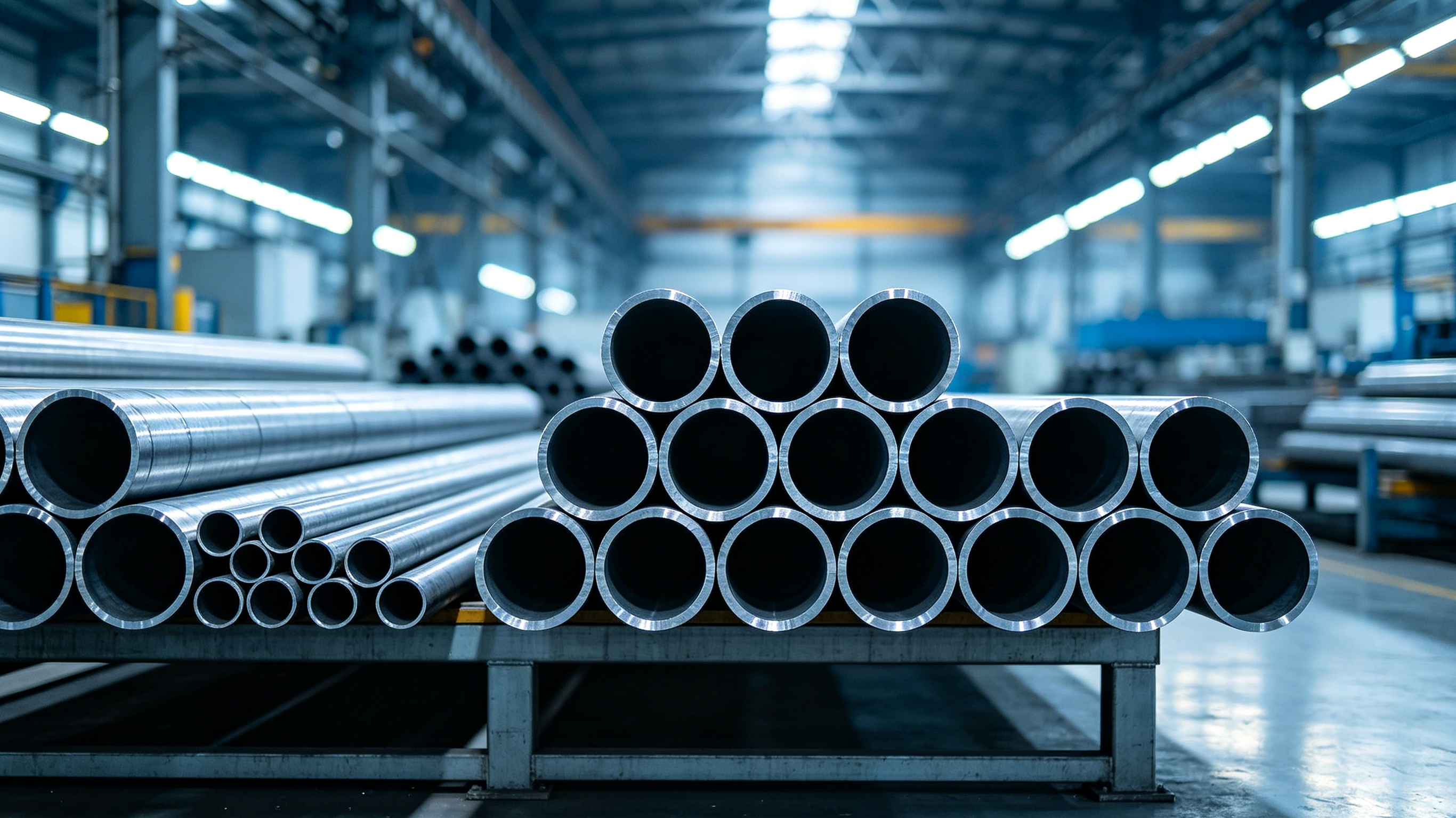
In modern industrial production, the 400 series stainless steel pipe serves as a vital component for heat exchangers, automotive exhaust systems, and high-pressure fluid lines. The 400 series group includes ferritic steels like 409L and 430, as well as martensitic steels like 410 and 420. Unlike common 300 series metals, these specific alloys require highly precise heating and cooling settings during production due to their unique magnetic and structural properties.
To help procurement managers and engineers understand how these materials are made, factories split production into two primary methods: seamless and welded processing. In this guide, we will break down the complete step-by-step manufacturing workflows for both types of steel tubing.
The Complete Production Process for Seamless 400 Series Pipes
Seamless steel pipes are crafted from one solid piece of metal without any joints or longitudinal weld zones. Consequently, this continuous structure distributes mechanical stress evenly, making it the perfect choice for high-pressure and safety-critical applications.
1. Raw Material Inspection and Heating
The manufacturing journey begins with solid round steel billets. First, workers inspect the chemical layout of the steel and grind down any surface cracks or imperfections. This step is critical because minor surface flaws can expand into deep splits during the hot-working stage. Next, the billets enter a massive rotary furnace for high-temperature heating. Ferritic steels (409L/430) are heated to a precise window of 1100°C to 1180°C, while martensitic grades (410/420) are kept between 1050°C and 1120°C to prevent grain coarsening.
2. Rotary Piercing and Size Reduction
Once the billet becomes white-hot and soft, a rotary piercing mill drives a pointed mandrel straight through the center of the solid block. This action forcefully tears the solid metal into a hollow raw tube. Afterward, a mandrel mill reduces the wall thickness, and a multi-roll sizing mill refines the outer diameter to match strict dimensional limits. The pipes then pass through rapid air-cooling stations to prevent thick oxide scales from building up on the metal surface.
3. Customized Heat Treatment and Straightening
Because different 400 series alloys react differently to heat, factories use distinct thermal processes to finalize the material strength:
-
Ferritic Tubing (430/409L): Tubes pass through a continuous annealing furnace at 800°C to 880°C followed by slow cooling. This process removes internal stresses and makes the metal soft enough for easy bending and stamping.
-
Martensitic Tubing (410/420): Soft-state tubing undergoes standard annealing at 750°C to 820°C. However, for high-pressure or wear-resistant tubes, workers apply a comprehensive quenching and high-temperature tempering process to maximize physical hardness.
Finally, the tubes pass through an automated multi-roll straightening machine to fix any bends, followed by shot blasting or acid pickling to strip away dark surface oxides.
4. Testing, Sizing, and Finishing
Before shipping, the straight pipes undergo strict non-destructive testing, utilizing both eddy current and ultrasonic equipment to check for internal flaws or uneven walls. Next, the tubes are cut to exact lengths. Depending on client blueprints, the inner and outer surfaces receive mechanical mirror polishing, hair-line brushing, or chemical passivation. Finally, every single pipe undergoes a hydrostatic water pressure test to guarantee there are zero leaks before final packaging.
The Complete Production Process for Welded 400 Series Pipes
While seamless manufacturing focuses on solid billets, welded tube production relies on continuous automated machinery to turn flat steel strips into high-strength hollow tubes. This method offers excellent wall consistency and cost efficiency for fluid transport and structural frameworks.
1. Slitting, Leveling, and Continuous Roll Forming
The process starts with large coils of cold-rolled 400 series stainless steel strips. A slitting machine cuts the wide metal sheets into narrow bands matching the target pipe diameter. These strips pass through leveling rollers to become perfectly flat before entering a continuous roll forming mill. Inside this machine, a series of shaped rollers gradually bend the moving flat steel strip into a tight, circular hollow shape.
2. High-Frequency Welding and Bead Removal
As the edges of the rolled strip meet, a high-frequency induction welding system concentrates intense electrical energy on the seam. The machine melts the meeting edges instantly and presses them together to create a continuous longitudinal weld joint. Because 400 series alloys conduct heat differently than 300 series variants, operators adjust the welding power and tube speed precisely. Immediately after welding, automated internal and external scraper blades slice off the raised weld beads, leaving the tube walls smooth to prevent future fluid clogging.
3. Inline Heat Treatment and Sizing
Welding naturally introduces localized stresses and hardens the area near the seam. Therefore, inline thermal treatment is a mandatory step:
-
For ferritic 430 and 409L pipes, inline rapid annealing eliminates weld stress to stop the tube from splitting during future fabrication.
-
For martensitic 410 and 420 pipes, the weld zone can become highly brittle. Consequently, the production line uses inline solution treatment and slow cooling to lower the risk of joint cracking.
After cooling down, multiple sizing rolls refine the outer roundness and straighten the pipe in one continuous motion.
4. Quality Detection and Surface Finishing
An inline eddy current testing system monitors the moving pipe in real-time, automatically marking and cutting away any sections with weld pinholes or micro-cracks. After cutting the tubes to exact customer lengths, the pipes undergo surface pickling or mechanical polishing to maximize corrosion resistance. Finally, batches go through hydrostatic pressure tests, visual dimension checks, and salt spray testing before being labeled and packed for international delivery.
FAKESI: Your Global Partner for Precision Steel Profiles
Sourcing traceably tested 400 series stainless steel tubing requires an experienced industrial partner. FAKESI (Wuxi Jiangbo Intelligent Technology) operates as a world-class precision manufacturer specializing in advanced high-tolerance seamless tubes and customized geometric profiles. By exploring our high-precision steel tubing factory, global procurement managers can see exactly how we optimize raw alloys into high-performance industrial components.
Through calibrated multi-roll straightening systems and advanced thermal processing, FAKESI delivers flawless steel profiles that integrate perfectly into automated production lines. Our technical team ensures that every batch combines absolute dimensional straightness with structural safety, allowing international clients to eliminate secondary manual adjustments and reduce overall factory labor costs.
Conclusion
In conclusion, both seamless and welded 400 series production lines require strict technical controls to handle the metallurgical traits of ferritic and martensitic alloys. By matching the right manufacturing method with precise heat treatments, factories can produce highly reliable piping engineered for demanding industrial tasks.
If you need a trusted global supplier that understands international quality standards and offers custom precision steel profiles, look no further than FAKESI. Visit our website today to review our processing capabilities or contact our engineering team to design the perfect tubing solution for your next project.


